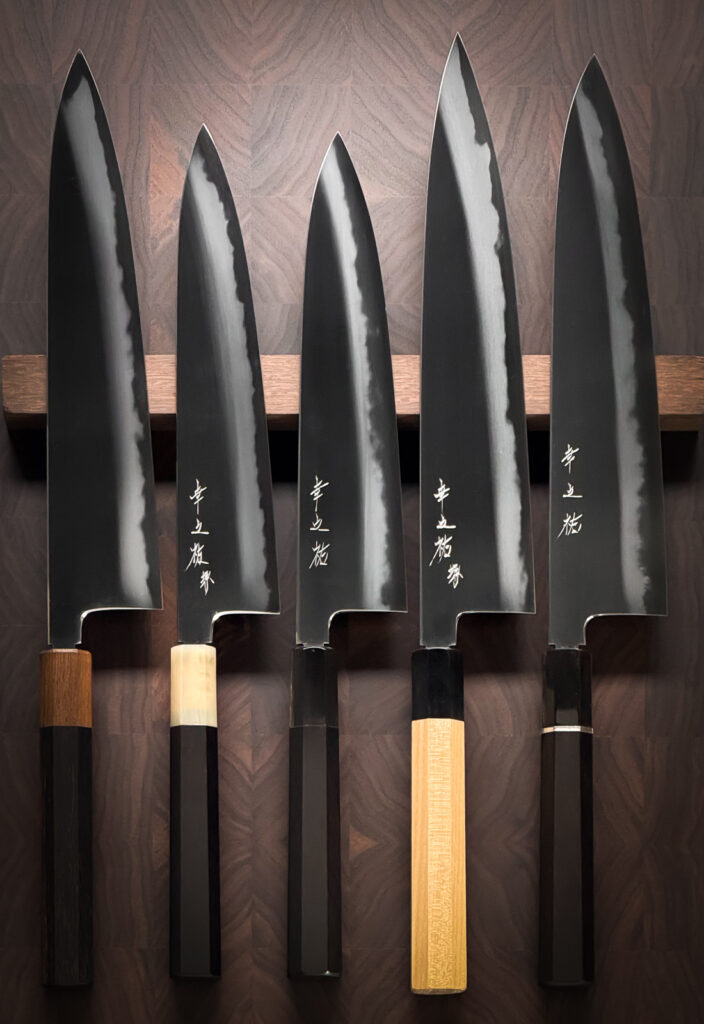
While the original Fujiyama remains Konosuke’s most celebrated line, the Fujiyama FM has quickly become one of its most popular among collectors.
| FUJIYAMA FM Years Made 2018 – Present Blacksmith Yoshikazu Tanaka Sharpener Myojin Naohito | Marking Patterns K-F-01 2018-2020 K-F-02 2018-2020 K-F-03 2018-2020 K-F-04 2018-2020 K-F-04-NS 2018-2020 K-FM-01-NS 2020-Present |
Konosuke introduced the Fujiyama FM knife line on Instagram in June of 20181. The knife featured a hamaguri (convex) grind and was sharpened by a then-unnamed craftsman. Speculation as to the identity of this secret sharpener persisted for nearly two years.
On March 7, 2020, Konosuke publicly confirmed2 that Myojin Naohito was responsible for sharpening the line and announced that knives he finished for the company would bear a distinctive identifying stamp. The company explained the change as follows:
“From this point on, all knives Myojin sharpens for Konosuke will have this ‘kokuin’, to help our faithful fans from around the world better identify Myojin’s excellent work.”
-Konosuke, Instagram
Myojin’s kokuin depicts Mount Fuji with a rising sun, forming a compact pictorial signature.
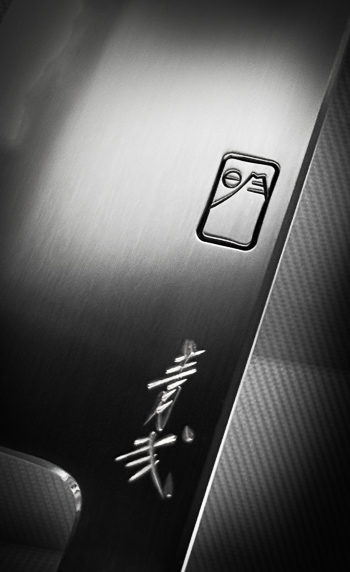
Collection of the Author
Knives produced prior to this announcement lack the Myojin mark and are commonly referred to by collectors as “pre-stamp FMs.” Examples bearing the kokuin are generally known as “stamped FMs.”
Konosuke has been notably consistent in the placement of Myojin’s kokuin, which appears on the left face of the blade. On gyutos, the mark is typically positioned approximately 35 mm from the choil.
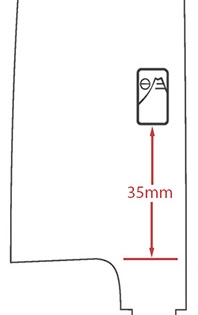
The FM Togo Reigo and KAIJU lines employ different placements of Myojin’s kokuin, discussed in their respective sections.
FM Knives Lacking Sakai Mark
Collectors will note that Fujiyama FM knives bearing Myojin’s kokuin do not display the Sakai mark on the blade.
The reason appears to relate to the location of the final sharpening work. Myojin Naohito sharpens Konosuke knives from his workshop in Susaki City on Shikoku Island, more than 175 miles southwest of Sakai City. Because a significant stage of production—specifically the final grinding and sharpening—is performed outside Sakai and the Osaka prefecture, the knives do not meet the criteria required to bear the Sakai stamp.
As a result, Fujiyama FM knives typically omit the Sakai marking despite their close association with Sakai-based production.
Laser Made Kokuin on FM Thin Type
Around 2022–2023, Konosuke introduced an exceptionally thin variant of the FM, commonly referred to as the “Thin Type.” The knives were released without formal announcement, though the box label identified the model accordingly.
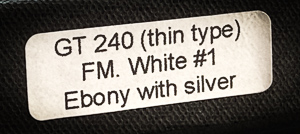
Early Thin Type examples retained the standard stamped Myojin kokuin. Over time, however, collectors began noticing subtle differences. The mark appeared unusually crisp, the recessed areas shallower, and the interior walls lacked the smooth compression typical of a struck stamp.
Konosuke later confirmed that the mark was being applied by laser engraving. On extremely thin blades, the force required for conventional stamping risked deformation of the blade surface. Laser engraving provided a more precise and lower-impact alternative.
The transition appears to have occurred sometime between late 2023 and early 2025. Thin Type knives produced in 2023 still display the traditional stamped kokuin, while examples documented in early 2025 show the laser-engraved version. The difference is readily visible: the laser mark is sharply defined and uniform, without the compressed steel characteristic of a struck impression.
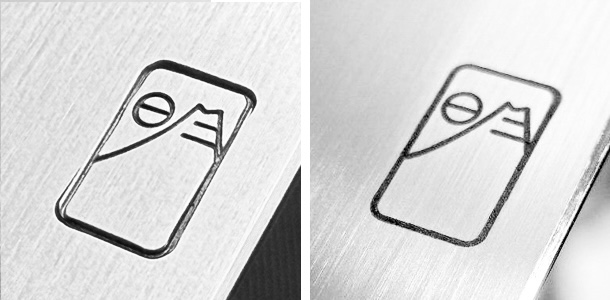
Laser Image courtesy of Reddit user marccheahmz
Early FMs
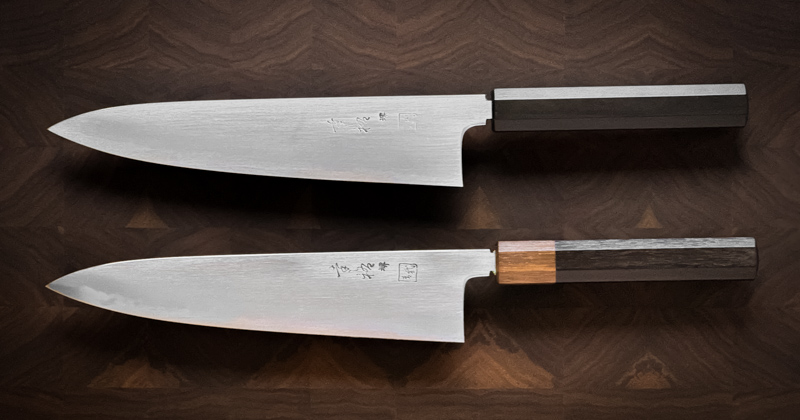
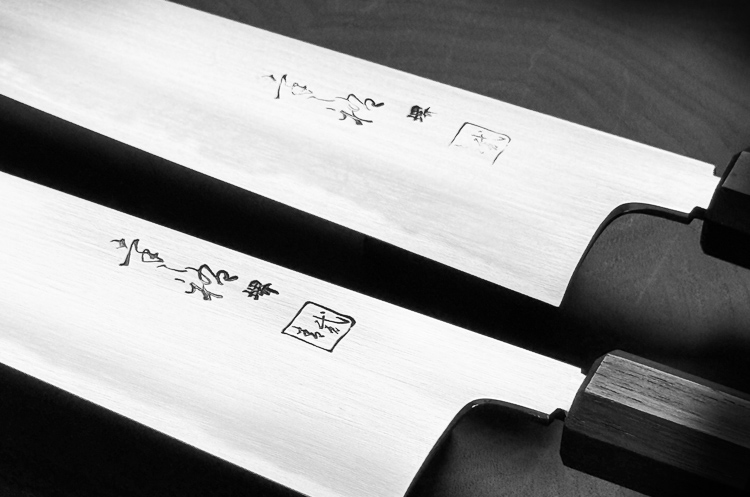
Certain early Fujiyama FM knives produced in 2018 can occasionally be confused with a limited run of Fujiyama hamaguri-ground knives sharpened by Morihiro. Both share a similar arrangement of Konosuke, Sakai, and steel kokuin stamps on the left face, making careful identification necessary.
In most cases, the box label provides the clearest distinction. Morihiro himself confirmed that one example in my collection—lacking its original box label—was sharpened by him and was therefore a Fujiyama and not an FM.
FM Marking Variation
Because the introduction of the Fujiyama FM coincided with two broader changes within Konosuke production—the gradual transition from stamped markings to hand-chiseled kanji, and the introduction of Myojin’s identifying kokuin:
The FM line exhibits more marking variation than any other Konosuke line to date.
Examples shown below illustrate several of the known configurations. Each knife pictured is a Fujiyama FM, despite the differences in marking style and arrangement.
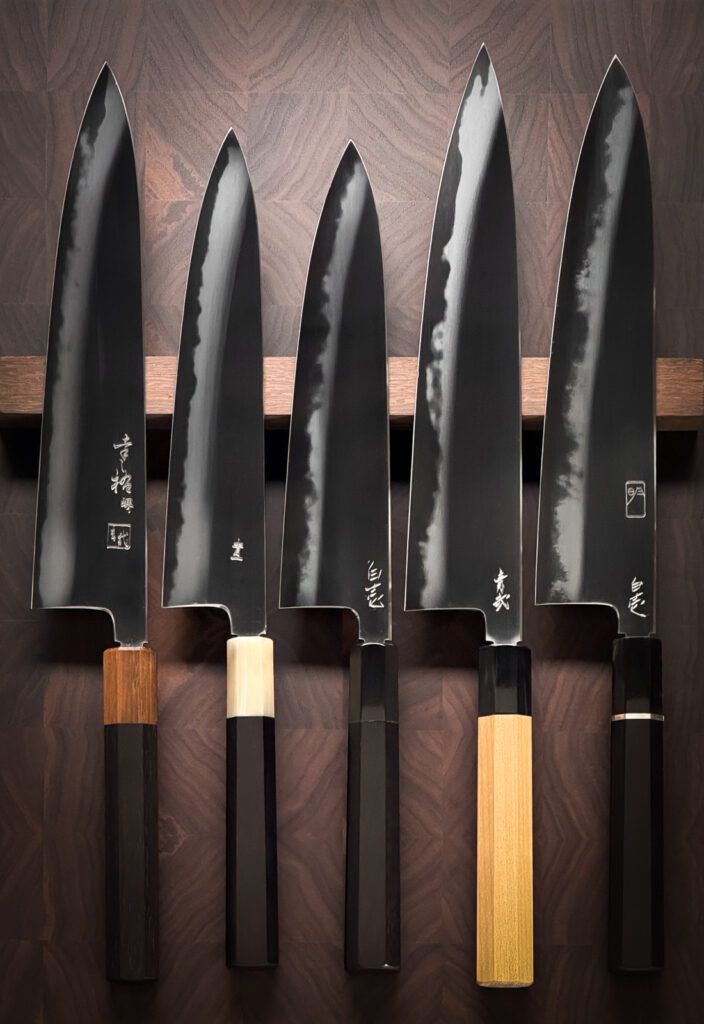
L to R:
Fujiyama FM (pre-stamp) 240 Gyuto in Aogami #2 (stamped Konosuke logo & steel kokuin) circa 2018
Fujiyama FM (pre-stamp) 210 Gyuto in Aogami #1 (steel stamp & chiseled Konosuke kanji) circa 2018/2019
Fujiyama FM (pre-stamp) 210 Gyuto in Shirogami #1 (chiseled steel & Konosuke kanji. No Sakai kanji) circa 2018
Fujiyama FM (pre-stamp) 255 Funayuki Gyuto in Aogami #2 (chiseled steel and Konosuke kanji) circa 2018
Fujiyama FM (stamped) 240 Gyuto “Thin Type” in Shirogami #1 (Myojin kokuin stamp, chiseled steel & Konosuke kanji. No Sakai kanji) circa 2022/2023